Quanda
We conceived, designed and engineered a complete operating system for football agencies. The brand, the deal room, the marketing site and the player's own iPhone app, built as our own venture.

Introduction
Quanda is an operating system for football agencies, built by Senso with a founding partner, holding players, deals, documents and the client relationship in one place. We made every layer of it, the brand identity, the web application, the marketing site and a native iOS app that agents and their players each log into.
A business that runs on trust, run on spreadsheets
The relationship was never broken. The record of it was.

The agents workspace
A player rarely sees where their own deal stands, or what their agent is doing week to week. Meanwhile an agency of three to fifteen people runs careers worth millions on spreadsheets, WhatsApp and inboxes.
Generic CRMs hold a pipeline. They cannot know that a wage column must never reach an associate, or that a client is seventeen and the rules have just changed.
What if the player held a key to their own career?
Every product here is built for the agency alone. The player is the subject of the record and never a reader of it. Giving them an account changes what the software is for.
Serious software, not sports software
The category dresses like a broadcast graphic. Quanda does not.
The brand carries two audiences. To an agency this is operational software, sitting beside their banking. To a player and their family it is where their career lives.

One colour, used sparingly
Violet
#5341C8
Canvas
#F7F8FA
Card
#FFFFFF
Border
#E2E4E9
Ink
#0B0B0E
Muted
#62656E
One colour is a constraint that pays for itself. When violet only ever means act on this, a screen holding four hundred numbers still tells you where to look.
Sofia Pro
Eighteen goals in twenty-six starts
Numerals set in tabular figures so a column of wages or minutes lines up on the decimal and can be read down rather than across. No mono face anywhere. Mono reads as a developer tool, and this is a business record.

The identity in application
Familiar first, distinctive second.
Quanda is adopted by agents who live in WhatsApp and spreadsheets, many of whom have rejected a CRM before. A pipeline has to look like a pipeline.
Two rules keep it honest. No interface text below twelve pixels, ever. Secondary text is a muted colour at full opacity, never the same colour faded.
The part that cannot go wrong
An agency's whole business sits in here. One leak ends a relationship.
A wage, a fee, a release clause. If the wrong person inside an agency sees one, it is not a bug report, it is a client lost. Permission is decided once, in one place.
Then we paid for the review that tries to break it. Seven specialists, each from a different angle, every finding argued against by a reviewer paid to dismiss it. Fifty survived, and all were fixed before a single agency signed up.
Safeguarding is product design, not policy
A policy is a document. A rule the app will not let you break is a control.
Age is derived from a date of birth and never stored, with three states rather than two. Minor, adult, and unknown, which fails closed. A call to a player under eighteen cannot be dialled until a colleague is named as the second adult.
Disappearing messages are unavailable on a thread with a minor, and the thread says why. A call with a minor cannot be deleted by anyone, including the agent who was on it.
The whole agency, one place
Players, contacts, clubs and brands, and every deal between them.
Four record types carry the business. Players, contacts, clubs and brands, each a record in its own right rather than a text field, so a club profile lists its players and the deals attached.
Offers from competing clubs sit side by side, wage against fee against contract length. Commission is modelled as structured economics rather than prose, so the numbers can be totalled.
Career history is not a contract table
A move is a fact about a career, not a row that overwrites the last one. An agent pitching a player needs the whole arc, so history and contracts are kept apart on purpose.
Eighteen goals is not a fact until you say over what, and when.
Season statistics are held one row per season per competition, the grain a scout talks in. The time window is a control rather than an assumption, and every number on the page follows it.
An agency that fits in a pocket
The desk work, on the touchline.
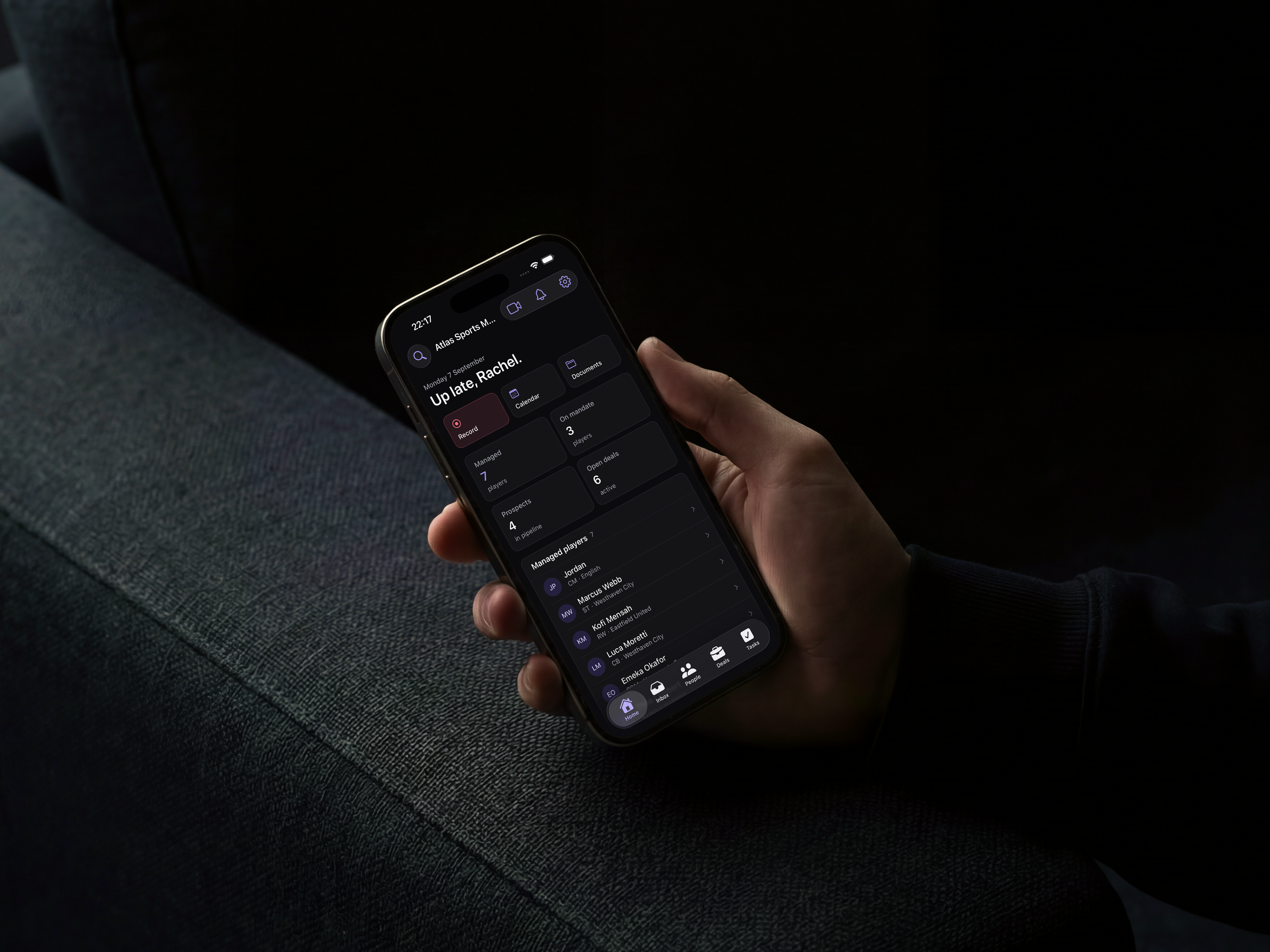
Agents do not work at a desk. They are at a training ground, in a car park, in an airport, and the moment something is agreed is rarely the moment anyone is near a laptop.

A call, inside the app
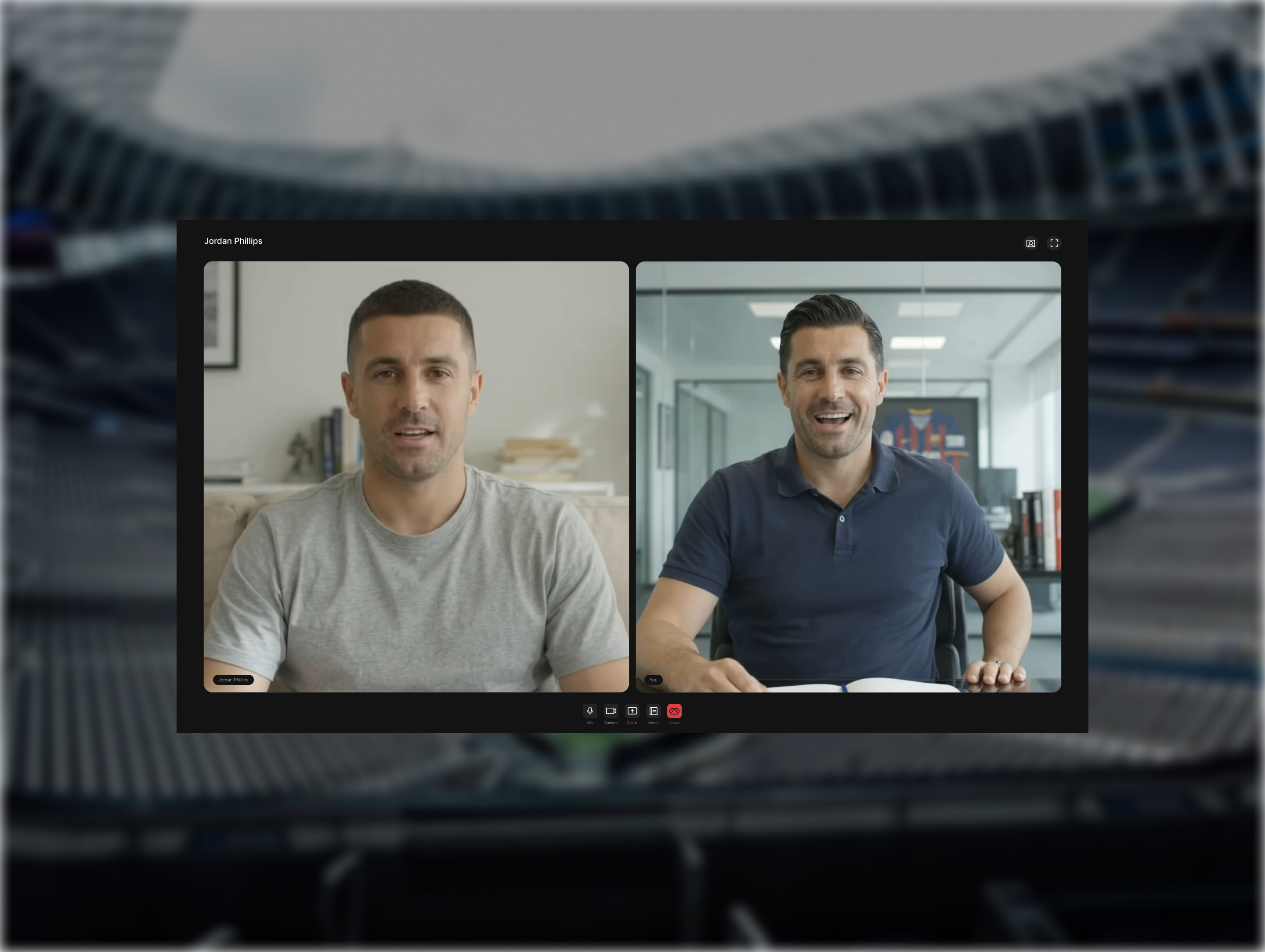
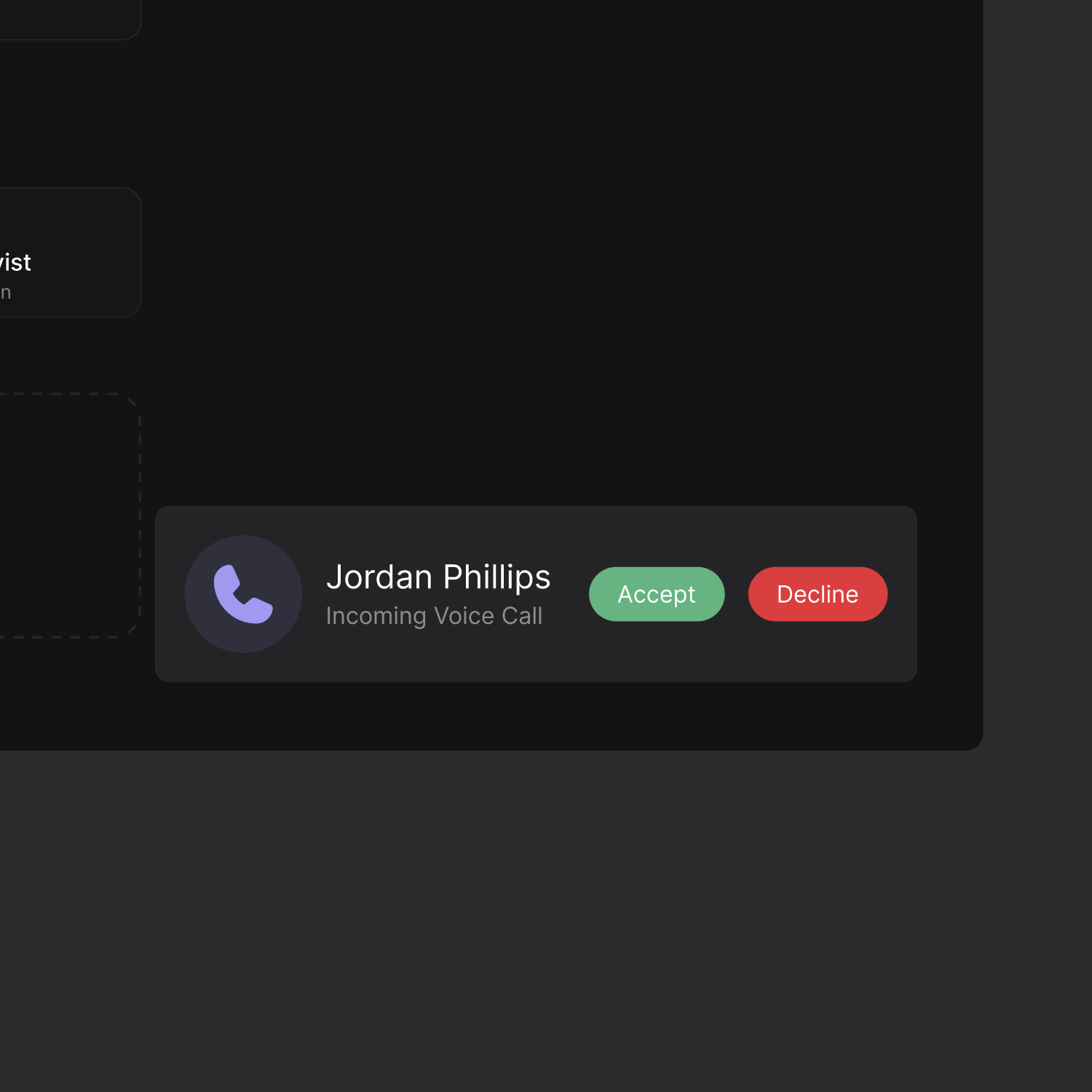
Two things a browser handles badly earn their place. Calls run inside the app and ring like any other call. A meeting can be recorded where it happens, rather than written up from memory in the car.
The other half of the relationship
Same account, seen from the side that has never had a view of it.
A player opens the same app and gets something else entirely. Their own deals and how far along each one is, their documents, their calendar, and a way to book time from their agent's real availability.


This is not the agency's view with the sensitive fields stripped out. A player's question is not how the pipeline is doing, it is what is happening with me.
A marketing site that cannot lie
Built on the product's own feature record, and audited against it.
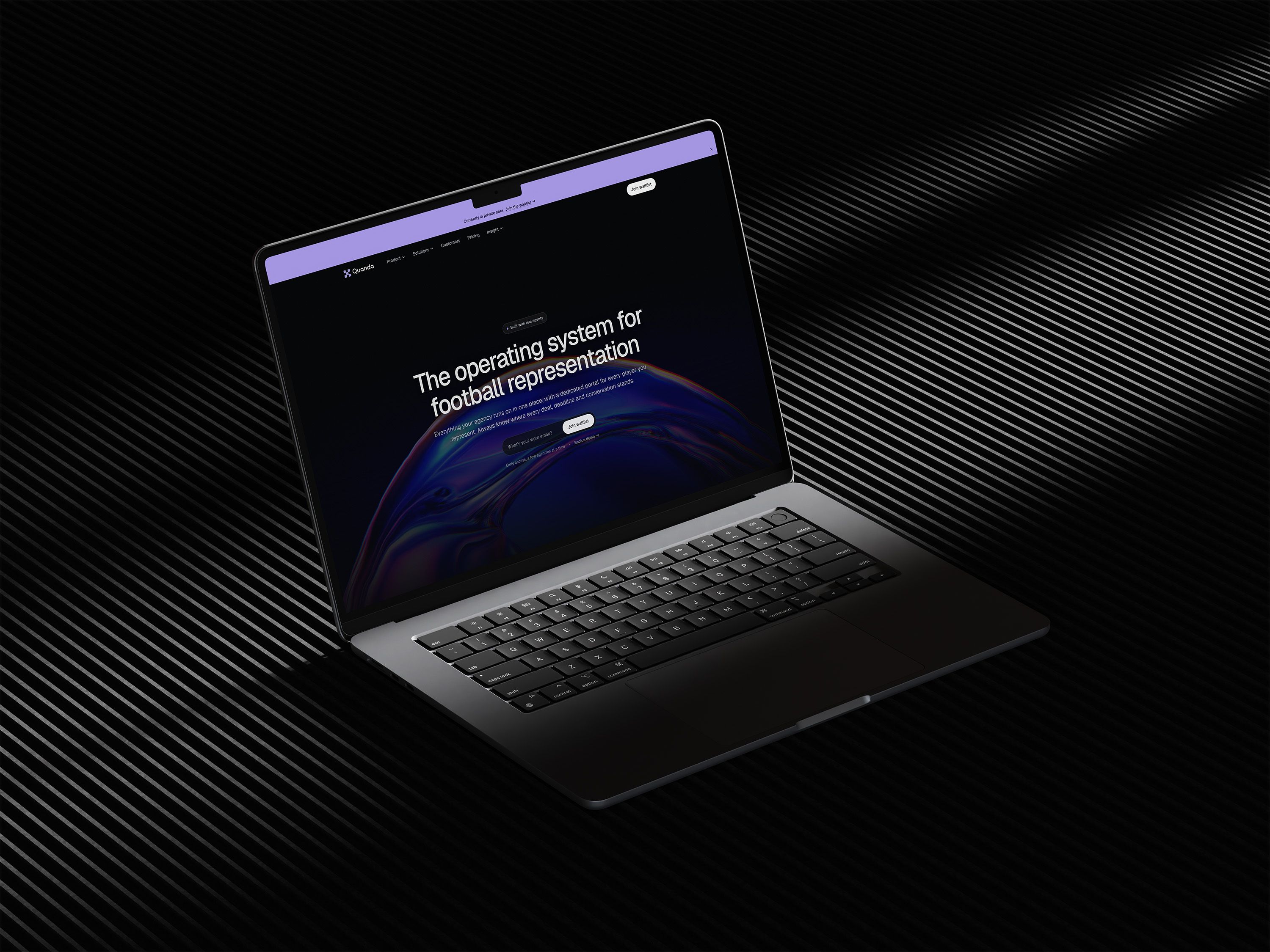
Software marketing drifts from software. A feature gets written about a month before it exists, and the day someone cannot find it is the day they stop believing the rest of the page.
So we audited the live site against the product's own record. Twenty-two pages, 636 strings of copy, 244 checkable claims. Invented traction numbers came off, and an Android app we had not built came off.

A venture, shipped whole
Quanda ships as a complete operating system for football agencies, with the player holding their own key to it. Signing runs through Signet, our own venture, so one Senso product sits inside another.
The outcome
Invested, built and shipped by Senso. The identity, the web application, the marketing site and a native iPhone app for agents and the players they represent.
1
Place where every permission is decided
50
Security findings fixed before anyone signed up
4
Products shipped, brand to iPhone app
Got a project in mind?

