Signet
Signet is a Senso venture. E-signing for founders and small teams, where the agreement looks like your business, your client signs without an account, and the record is sealed with proof anyone can check.

Introduction
Signet is provable e-signing for modern businesses. You send a contract, a proposal or an NDA, it is signed in one tap with no account, and every document is sealed with a verifiable record it was not changed. It is a Senso venture, and we built all of it, the strategy and positioning, the brand and identity, the product design, and the engineering.
Our own agreements arrived looking like someone else's product.
Every proposal and contract we sent went out through a tool that stamped its own look on our work. The last thing a client saw before signing was not us.
The e-signing we could buy solved the sending. It did not solve the arriving, and it kept the record of what happened to itself.
Proof over promises.
Old e-signing asks you to trust its record. Signet makes a record you do not have to trust, one anyone can check for themselves.
A signet ring, rebuilt in software.

The seal mark
For centuries a signet ring pressed a mark into wax that only its owner could make. Instant, personal, and impossible to fake convincingly. That is the product, not the decoration.
Evidence, made handsome.
Name, mark and type, all doing the same job.
The name came from the object, not a thesaurus. A signet ring already meant a mark only its owner could make, so the word arrives carrying the proof.
The logomark is that seal seen head on. Concentric rings stand for the layers of proof, the document, the trail and the certificate, and one ring is dashed, the tamper line that breaks when something changes.
It is drawn to survive a favicon and an app icon, so the mark still reads wherever the product turns up.
Instrument Serif carries the wordmark, because a serif says paper and the category says software. Geist keeps the interface current, and Geist Mono makes every hash look like a record rather than decoration.
The ground is warm paper, the ink is near black, and a single vermilion is spent sparingly, on the seal and the moments that carry weight.
One colour as proof
Seal
#FF5900
Ink
#17130F
Ground
#F2F0EA
Line
#E5E0D6
Muted
#6B655D
Instrument Serif
Signed. Sealed. Provable.
Geist Sans carries the interface and Geist Mono carries the hashes, so the technical record looks technical.
Agreements that look like the business sending them.
Most e-signing staples fields onto whatever you upload. Signet renders the agreement from your own brand, so a proposal arrives looking considered rather than processed.
A library of ready agreements sits behind it, so an NDA or a proposal starts from something written rather than a blank page.
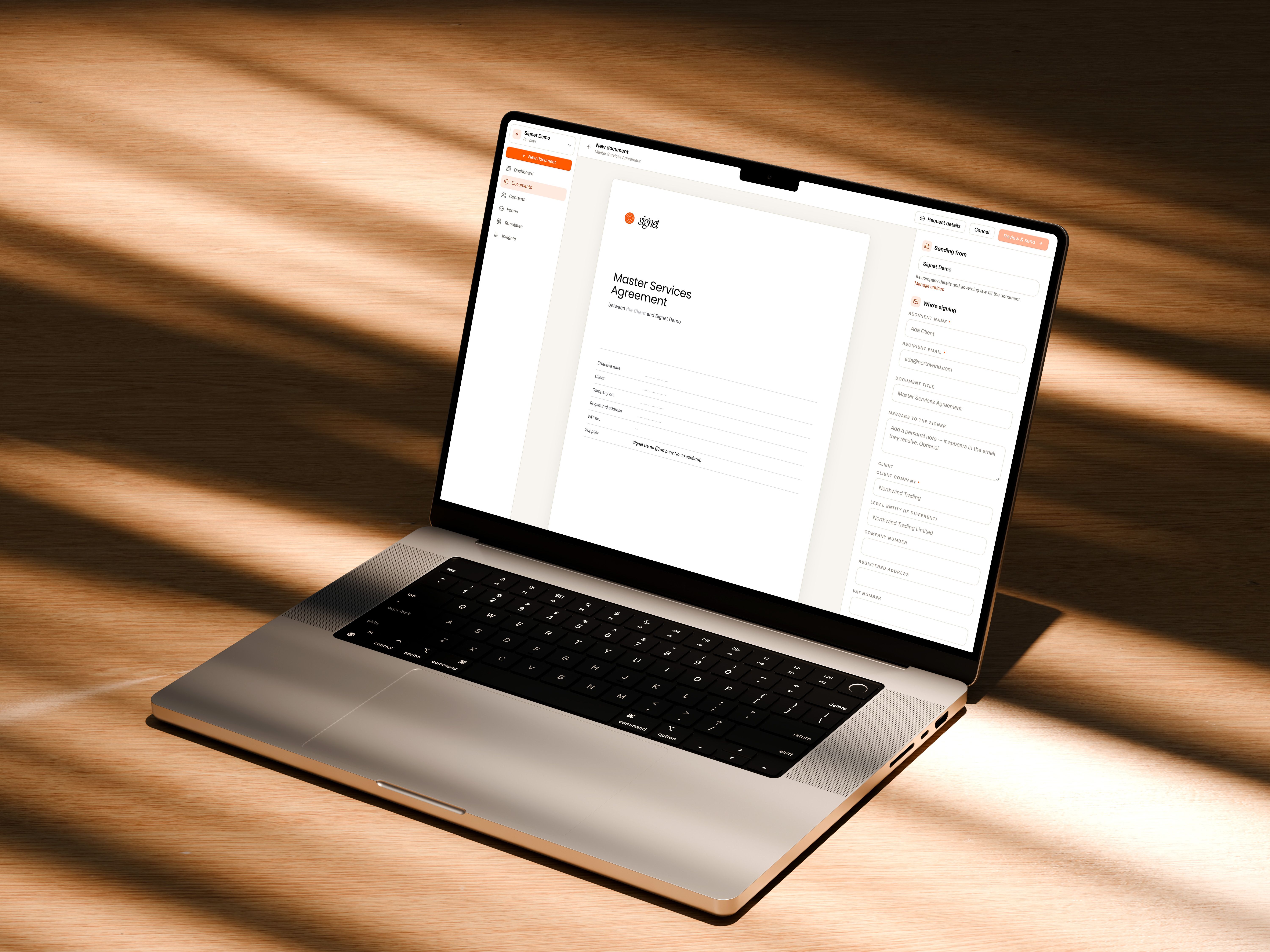
The document builder
A set of agreements, not a pile of links.
Sending five documents used to mean five emails and five links, and something always went missing. An envelope holds the whole set, and your client opens one place to find all of it.
Order matters too. The NDA before the contract, the contract before the schedule. An envelope keeps the sequence, so nobody signs the wrong thing first.
No account for your client, and it still has to stand up.
Removing the sign-up is easy. Removing it without weakening the record is not.
A secure link is the session. Your client opens it, reads, draws or types their name, and consents. No password, no sign up, and nothing to download.
The link is sent to a known address and belongs to one agreement, which is what ties the person to the signature. Consent and intent are shown plainly and recorded at the moment they are given.
Every event is hashed and timestamped as it happens, so the trail cannot be tidied up later. The whole flow is written to eIDAS and ESIGN for simple electronic signatures.
Sealed, and checkable by anyone.
Each completed agreement carries that append-only trail and a certificate of completion. The seal is a fingerprint of the document itself, so any change breaks it.
The verifier runs in the browser. It recomputes the fingerprint, checks the certificate and returns a verdict. Nothing is uploaded, and it works whether or not Signet is there.
An agreement is not finished when it is signed.
Signet keeps the calendar. Every agreement carries its dates, so renewals and expiries arrive as something you can see rather than something you remember.
It chases for you as well. Reminders go to whoever has not signed yet, which is the job nobody wants and everybody forgets.
A venture, built end to end.
Senso made all of it. Strategy, brand, product design and engineering, with a native iOS app and an API for teams that would rather send from their own systems.
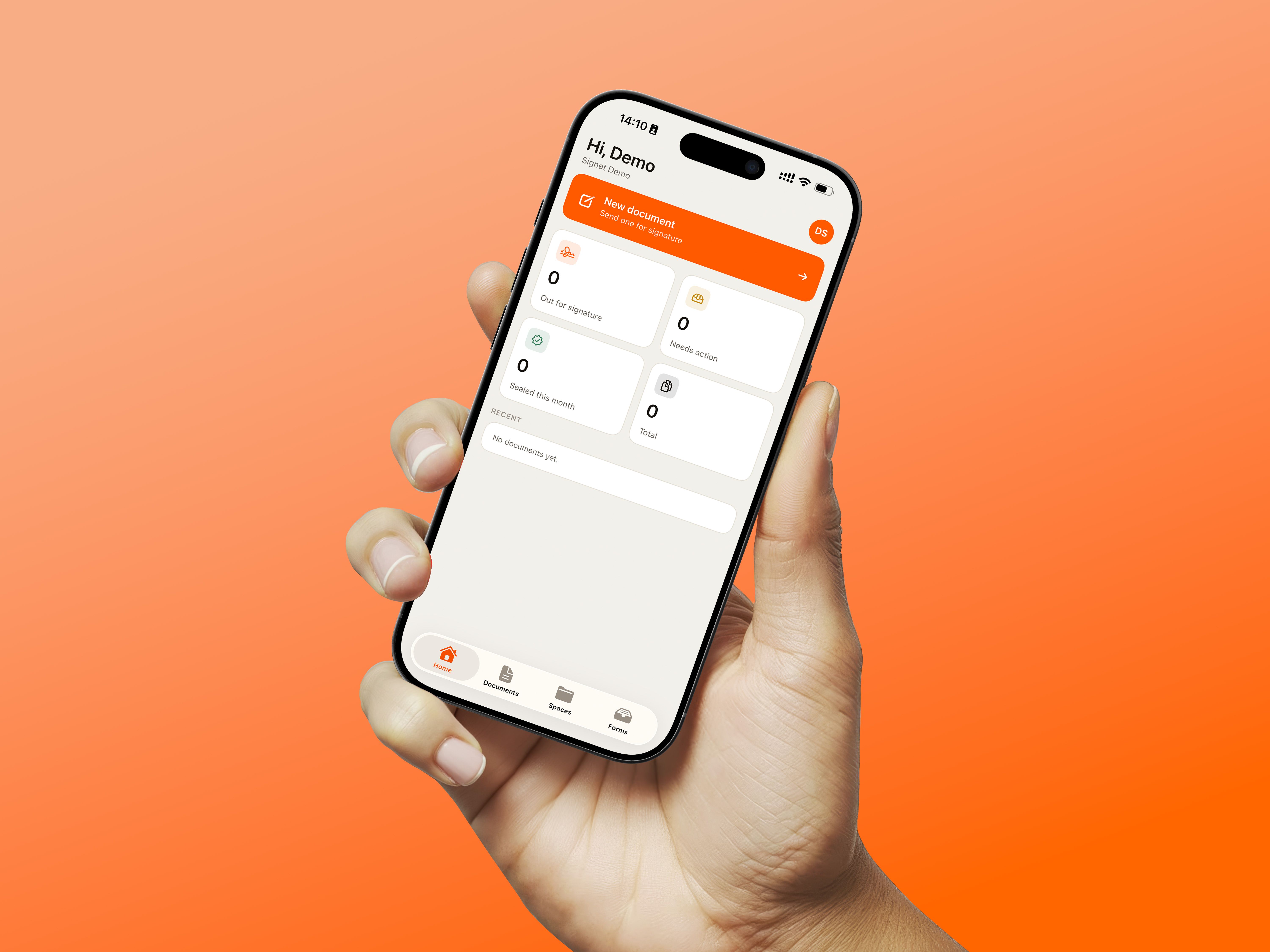
The marketing site is ours too. Ninety two pages of it, with 40 posts, 19 solution pages and 11 comparisons, and the prices published in the open where the category hides them.
Open, early, and built for founders.
Signet is open to anyone, with a free tier and paid plans, and it is early by design. It is made for founders and small teams who send agreements constantly and have no legal department.
Next is independent timestamping, so the proof is anchored outside us, and verified identity signing for the agreements that need a higher bar.
Got a project in mind?

